
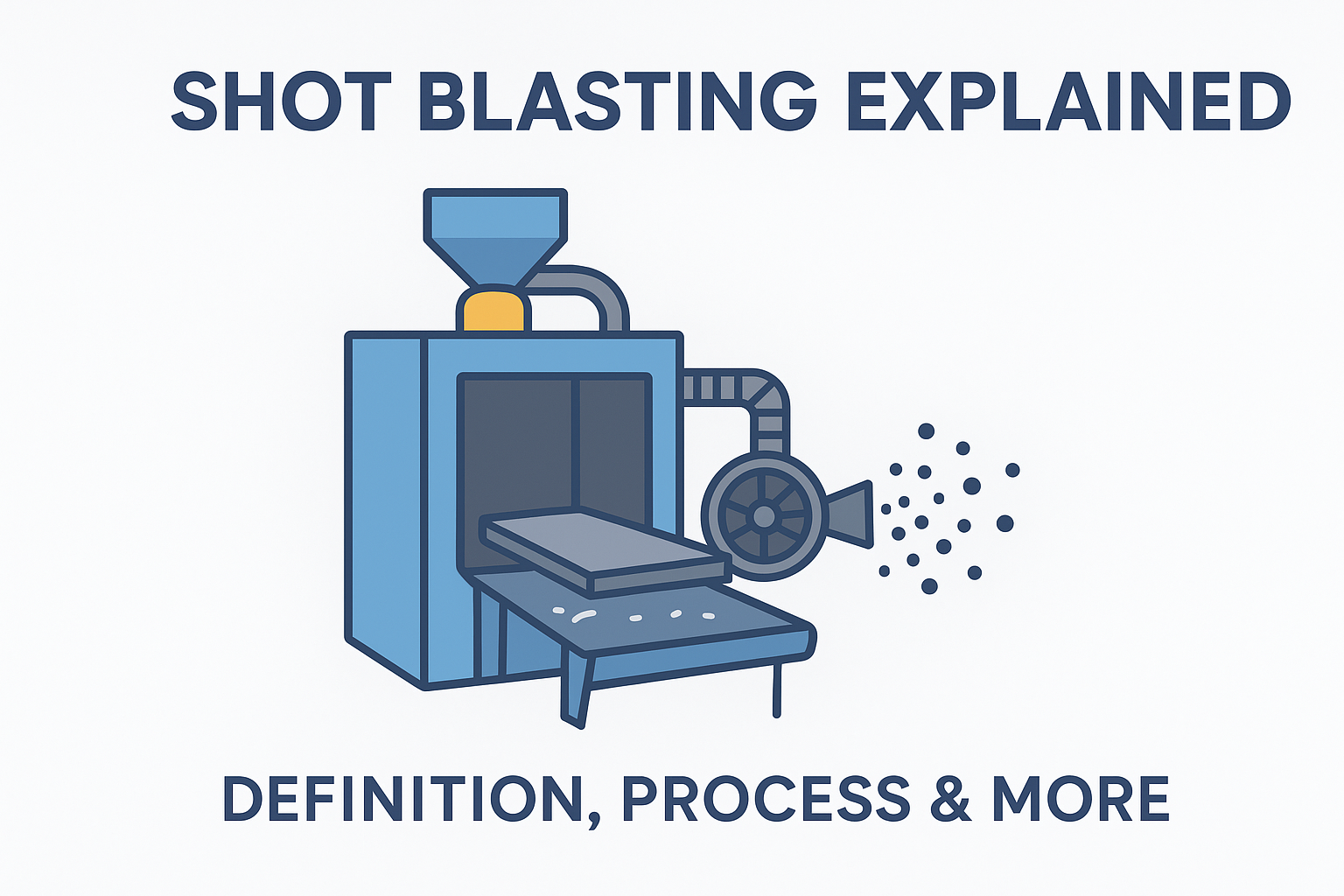
Shot blasting is one of the most popular and effective surface treatment processes among the numerous list of the current techniques in the market. It could be cleaning rust, preparing a surface to be painted, scaling a surface or hardening a component of metal; shot blasting is a repeatable process at a speed that is industrial. Here, we will divide into several parts and explain in detail what shot blasting is, how it works, the equipment used, advantages, and uses, as well as how it compares to other similar methods.
What Is Shot Blasting?
Shot blasting is a mechanical surface treatment process which involves high-velocity shots or pellets of abrasive steel onto a workpiece to clean, strengthen or polish the surface.
It is primarily used to:
Eliminate rust, corrosion and mill scales.
Ready surfaces to receive coatings, paint, and welding.
Enhance fatigue strength by shot peening.
Forges, fabricated parts and clean castings.
Administer homogeneous surface-level.
Sandblasting is usually mixed with shot blasting. Although both abrasives are used, shot blasting would normally require the use of metallic shot and would be done in a controlled machine that is more predictable and cleaner and would be appropriate when it comes to large-scale manufacturing.
How Does It Work?
The shot blasting is based on a blast wheel system or compressed air to propel shots of the metal at high velocity. Once such shots hit the surface, they hit and remove the contaminants as well as form a refined profile.
It is carried out in the following stages:
Loading the Workpiece
The component to be blasted is a piece of metal sheet, a fabricated piece, a casting or structural steel, which is loaded into a blast chamber. This may be achieved by:
A conveyor belt
A rotary table
A hanger/monorail system
A rolling drum (small parts).
This is aimed at ensuring that the component is blasted uniformly on all sides.
Abrasive Acceleration
The abrasive media (steel shots, grit, or beads) is accelerated in the shot blasting machine inside with either of the two methods:
B. V. T. Blasting (Centrifugal Force)
The shots are launched at high speeds of up to 75-100 m/s by a high-speed rotating wheel. It is the most widespread way and is applied in industrial automated systems.
B. Air Blasting (Compressed Air)
In this case, compressed air is used to force shots through a nozzle. It is also flexible and can be used in delicate or complicated shapes, but it is slower than wheel blasting.
Surface Impact and Cleaning
As the shots hit the surface:
Wear, rust, decaying paint, oil, and pollution flake off.
The surface is profiled (roughened).
The metal is strengthened by micro-deformation (shot peening effect).
The end result is a clean, uniform surface which is ready to be coated.
Collection and Recycling
The benefit of shot blasting is that the abrasive media, which is used, can be reused. After the blast cycle:
Shots that are used drop into a collection hopper.
A separator is used to remove dust and broken particles.
Wash shots go back to the storage hopper.
This cycle is repeated until the abrasive wears.
This renders shot blasting more economical and greener.
Its Abrasives Types
The kind of abrasive to use is determined by the nature of the finish to be achieved.
Steel Shots (Spherical)
Cleaning, surface polishing and peening.
Steel Grit (Angular)
Useful in harsh cleaning, rust removal and edge profiling.
Glass Beads
Applied to the surface, no dimensional changes – popular in aerospace.
Ceramic Beads
Good durability, to be used in precision.
Aluminium Oxide & Garnet
Applied to air blasting of non-ferrous.
The shot blasting machines are categorised into types.
Hanger-Type Shot Blasting Machine.
Applied to fabricated structures, welded parts and heavy components.
Tumble Shot Blasting Machine.
Application is ideal in small machine parts, gears and fasteners.
Spinner Hanger Machine
Can be used on medium-size parts that need a high standard of finishing.
Table Type Blasting Machine
Appropriate in flat items such as plates and moulds.
Continuity Conveyor Blasting Machine.
Applied in large-scale production like automobiles and structural steel.
Shot Blasting in Applications.
Shot blasting is very important in various industries:
Metal Fabrication
Eliminates the welding scale and burns and pre-treats surfaces to be painted or powder-coated.
Automotive Industry
Applied on engine blocks, gears, springs, chassis and wheel rims.
Foundry and Casting
Eliminates cast components, sand, scale and residues.
Construction and Structural Steel.
Assembles beams, plates, and columns prior to preparation to be painted or galvanised.
Aerospace
Shot peening enhances fatigue strength of aircraft components.
Shipbuilding
Washes hull plates, decks and marine parts.
Railways
Applied to bogies, wheels, axles and heavy structure elements.
Shot Blasting and Sandblasting.
Characteristics Shot Blasting History Sandblasting
Gritty Abrasive Steel shots/grit, sand, garnet, etc.
Method More or less automated wheel blasting with compressed air
Power More aggressive Less aggressive.
Dust Low dust (recycled) High dust
Uses industrial scale Small-scale, detailed work.
Shot blasting is applicable with big, heavy-duty industrial components, and sandblasting is commonly applicable in detail or on delicate surfaces.
Benefits of Shot Blasting
Superior Cleaning Quality
Eliminates rust, scale and contaminants.
Improved Adhesion
Produces an ideal painting, powder coating or plating surface profile.
Enhances Strength (Shot Peening)
Enhances fatigue strength, endurance and cracking resistance.
Environment-Friendly
Abrasive media can be recycled by using a hundred and less waste.
Fast & Efficient
Tonnes of material can be cleaned by automated shot blasting machines every hour.
Cost-Effective
Reduced cost of labour and durable abrasives make the costs less expensive.
Surface Standards of Shot Blasting
There are frequently certain grades of surface preparation required by industrial projects:
SA 1 – Light Cleaning
SA 2 – Commercial Blast
SA 2.5 – Very Thorough Blast (Most popular)
SA 3 – White Metal Blast
These standards maintain consistency in such industries as marine, oil and gas, and fabrication.
Safety Considerations
Safety is an essential factor in spite of the automated shot blasting:
Protective equipment should be put on the operators.
Dust collectors ought to be attached to machines.
Wear and tear inspection frequently.
Safe operation is guaranteed by appropriate training.
Final Thoughts
Shot blasting is a vital industry activity which improves the quality, strength and longevity of surfaces in a wide range of uses. The ability to clean, prepare and harden metal surfaces enables it to be indispensable to fabrication, construction, automotive, aerospace and heavy engineering industries. Surprisingly enough, shot blasting is one of the most effective, environmentally friendly, and economical methods of preparing surfaces with modern automated machines and recyclable abrasives.